
Adelaide startup Vocare uses speech AI to help multilingual aged care and disability support workers speak English clearly, so the people in their care understand them the first time. When a grant ended with working machine learning code and no GPU to run it, Vocare won a GIGABYTE AI TOP ATOM at SouthStart 2026, set it up with XENON and now trains its model locally, on its own data.
| Customer | Vocare (Vocare Speech Australia Pty Ltd), Adelaide, South Australia |
|---|---|
| Industry | Workforce communication for aged care and NDIS disability support providers |
| Need | Machine learning code built out through an AIML grant needed a GPU, and an early-stage startup had no budget to buy one, so renting was the only realistic route |
| Delivered | A GIGABYTE AI TOP ATOM (NVIDIA GB10 Grace Blackwell Superchip, 128GB unified memory, 4TB NVMe), won at SouthStart 2026 and set up with XENON in April 2026 |
| Results | Vocare trains its speech model locally on its own annotated data, with the data on hardware it controls |
| Partner | GIGABYTE, prize co-sponsor with XENON |
Background: helping care workers be understood the first time

Vocare works with frontline care workers who speak English as a second language. Some speak three, four or five languages. Vocare helps them speak English with clarity and confidence, so the older people and people with disability in their care understand them the first time. Founder and CEO Seshnie Taylor, a linguist, launched the Adelaide company in 2025. It now has over 225 users, and the number is growing every week. This year Taylor won the Social Impact Award at InDaily’s 40 Under 40 SA awards, and was a finalist for the moodi Female Founder Fund’s People’s Choice and for the FoundHer Launch Grant. Vocare is also a finalist in two Women in Innovation Awards categories: social impact and emerging innovator.
Its speech model listens as a worker speaks, detects mispronunciation in phonemes, the smallest units of sound, and then prescribes exercises to sharpen clarity. The focus is clarity and confidence; Vocare does not set out to change anyone’s accent. In its published 42-day pilot with one provider, run between October and December 2025, one participant’s score rose from 33.8% to 72.2% after repeating a single exercise 72 times.
Workers grow in confidence and in their careers. Providers, who Taylor says take on a risk to care quality when residents struggle to understand multilingual staff, report workers who are more talkative and more willing to speak up about things that need fixing. And the people receiving care can understand, and connect with, the people looking after them.
Working code, but no GPU to run it
A grant from the Australian Institute for Machine Learning (AIML) gave Vocare 300 hours with AIML’s machine learning engineers to build out its core machine learning code. When the project finished in March 2026, Vocare had working code, and advice from AIML that it would probably need a GPU to run it.
Vocare did not have the budget to buy a GPU, so the only realistic route without winning the ATOM was to rent GPU time from a cloud provider, with an hourly bill for every training run coming straight out of the company’s runway.
Keeping data local matters to Vocare too. Its model learns from annotated recordings of real frontline speech, and the company tells providers that all of its data is securely stored locally. Whatever compute it found had to be affordable now, and had to keep those recordings in Vocare’s hands.
That has a massive ripple effect on so many lives.“
Seshnie Taylor
Founder and CEO, Vocare

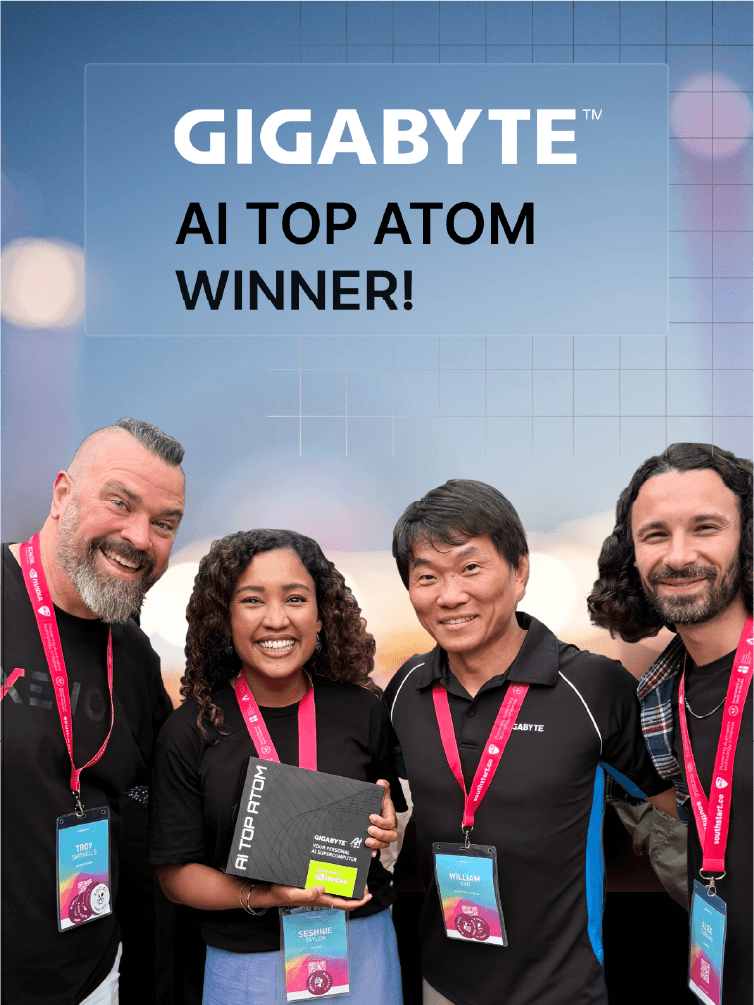
A GIGABYTE AI TOP ATOM from XENON, won at SouthStart 2026
That same month, XENON and GIGABYTE offered founders attending SouthStart 2026 in Adelaide (17 to 19 March) the chance to win a GIGABYTE AI TOP ATOM. Taylor entered, and Vocare’s entry was judged the winner.
The ATOM is what GIGABYTE calls a personal AI supercomputer: a compact system built on the NVIDIA GB10 Grace Blackwell Superchip and designed for on-premises AI development. Vocare’s unit has 128GB of unified memory and 4TB of NVMe storage. For Vocare, it meant a GPU of its own.
Set up with XENON
In April 2026, XENON Solutions Architect Malcolm Haak spent a couple of hours at Vocare on the day the ATOM came out of its box for the first time. Malcolm helped boot it up and trained Vocare’s machine learning engineer and software engineer to connect to it and set it up securely: a wired Ethernet connection, remote access over SSH, Tailscale for private remote access, and Cloudflare for exposing its services safely. The machine learning engineer then loaded the code from the AIML project onto the ATOM, where it runs in Docker containers on NVIDIA’s PyTorch software stack. By 15 April it was running behind a Cloudflare tunnel. The ATOM now serves Vocare’s live pronunciation assessments. It is also where the team trains and tests experimental models and tunes its scoring.
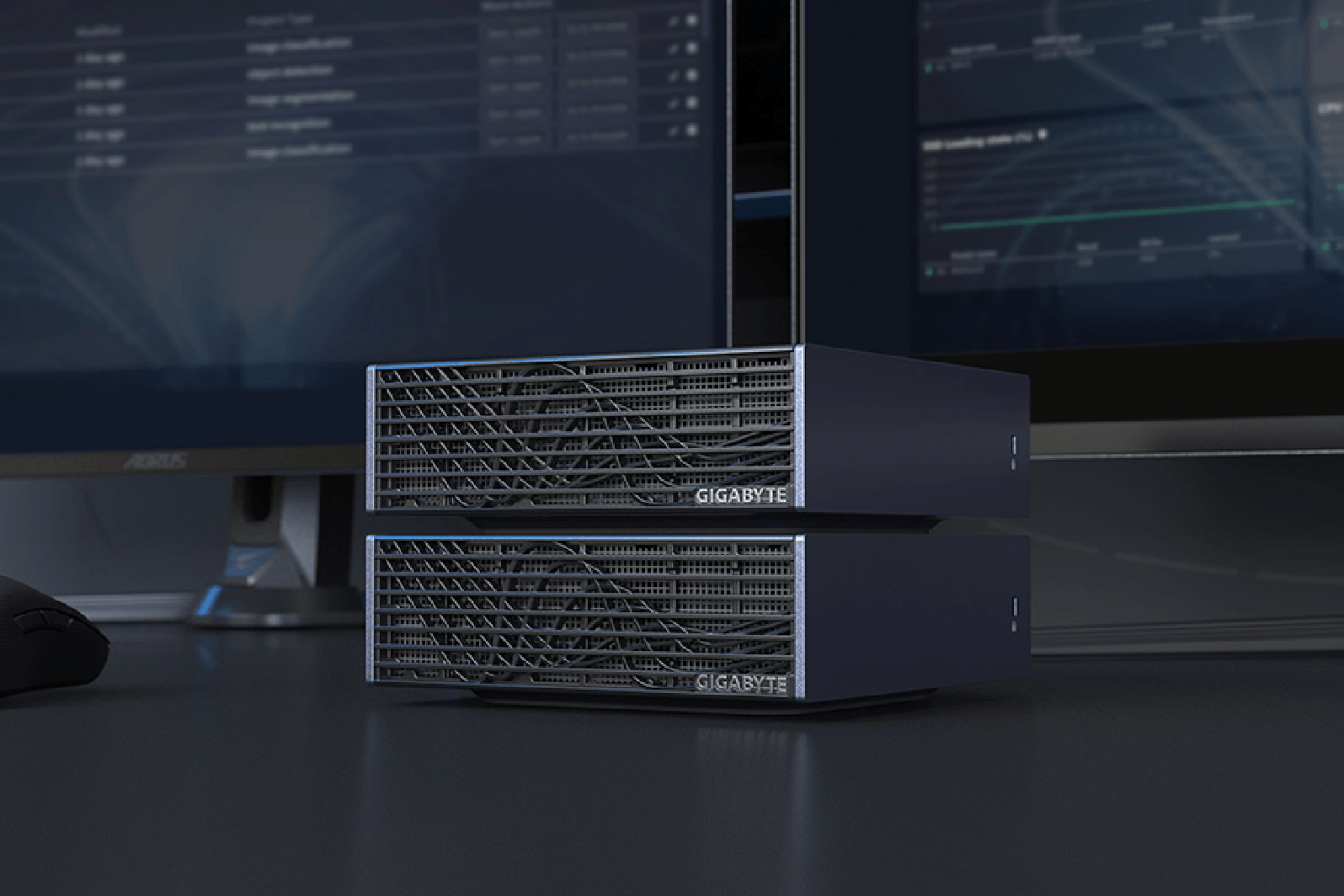
Compact AI Power. Limitless Possibilities.
The GIGABYTE AI TOP ATOM brings powerful NVIDIA Grace Blackwell computing to a compact desktop system, enabling startups like Vocare to develop, train and run AI models locally with greater control over their data and infrastructure.

Results: local AI compute, and training data under Vocare’s control
The ATOM put Vocare’s code to work as soon as it was set up. The team now trains its speech model on its own annotated data, locally, in what Taylor calls “a safe, secure and super fast way”. It trains on a proprietary dataset of more than 30,000 annotated workplace voice samples.
Training runs on local AI compute: the compute is Vocare’s own, so a run carries no hourly cloud cost, and the annotated recordings it learns from stay on a machine Vocare controls.
Seshnie Taylor
Founder and CEO, Vocare
All our training experiments sit on one machine. We can test a new idea in an afternoon, and learner audio never goes to a third-party cloud API.“
Linh Ung
Machine Learning Engineer, Vocare
About Vocare
Vocare (Vocare Speech Australia Pty Ltd) is an Adelaide company that helps multilingual frontline care workers speak English with clarity and confidence. Founded in 2025 by linguist Seshnie Taylor, it combines AI-powered pronunciation practice with face-to-face workshops for aged care and NDIS disability support providers. Its mission is to help as many skilled migrants as possible to speak with clarity and confidence in the care sector. Learn more at www.vocare.com.au.
About GIGABYTE
GIGABYTE is an enabler of next-generation computing, building a foundation for technology innovations that is robust, optimized, trustworthy, versatile, and accessible. Together with a global ecosystem of partners, we translate emerging technologies into real-world impact—accelerating AI adoption, advancing sustainable computing, and empowering businesses, communities, and individuals to unlock the full potential of computing. GIGABYTE. Upgrade Your Life. Learn more about Gigabyte.
About XENON
XENON designs, builds and supports high-performance computing, AI Factories, AI systems and data storage infrastructure for people solving the world’s most demanding problems. Since 1996, XENON has engineered the systems behind some of Australia’s hardest workloads, from training AI models and sequencing genomes to rendering feature films and executing trades in microseconds. From its Melbourne headquarters and Singapore office, XENON partners with research institutions, universities, government, defence and enterprise customers in Australia and around the world. Build Beyond Limits. Learn more at xenon.global.